



Stainless Steel Filter Screens — Applications and Selection
Flat, Formed and Sintered Filter Elements
Specify the Mesh and the Assembly
Polymer Melts | Filament Spinning | Process Filtration
Technical Selection
Use the approved component drawing, media specification and operating conditions to select the screen.
Final dimensions, layer sequence and performance requirements form the agreed supply specification.
Flat Screens and Bowl Shaped Packs
Define the Profile and Layer Construction
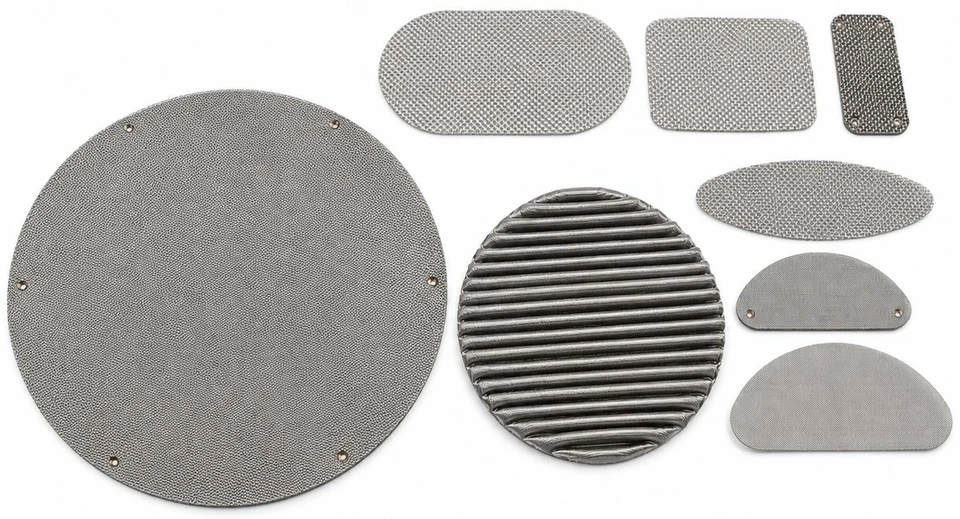
Circular Screen
Annular Screen
Semicircular Screen
Flat screens include round, rectangular, semicircular, waist shaped, hollow and custom profiles. Single layers and spot joined multilayer packs are offered, using woven mesh, Dutch weave or sintered fibre. Dimensions and layer count are customisable.
External Profile
Diameter or length/width; corner radii and profile tolerances.
Internal Features
Openings, location features and the active filtration area.
Media Stack
Material, weave or media grade, layer order and total thickness.
Edge and Joining
Edge finish, joining locations and the seating interface.
Formed Bowl Screens
Confirm the profile, edge and total stack thickness.
D is the outside diameter; H is the formed depth.
Bowl shaped screens are available in single or multiple layers. Add formed depth, wall profile and seating details to the component drawing.
Fit and Support
Confirm that the screen is seated and supported across its working area. Keep the layer sequence and flow orientation linked to the equipment drawing.
Sintered Filter Screens
Bonded Mesh for Dimensional Stability
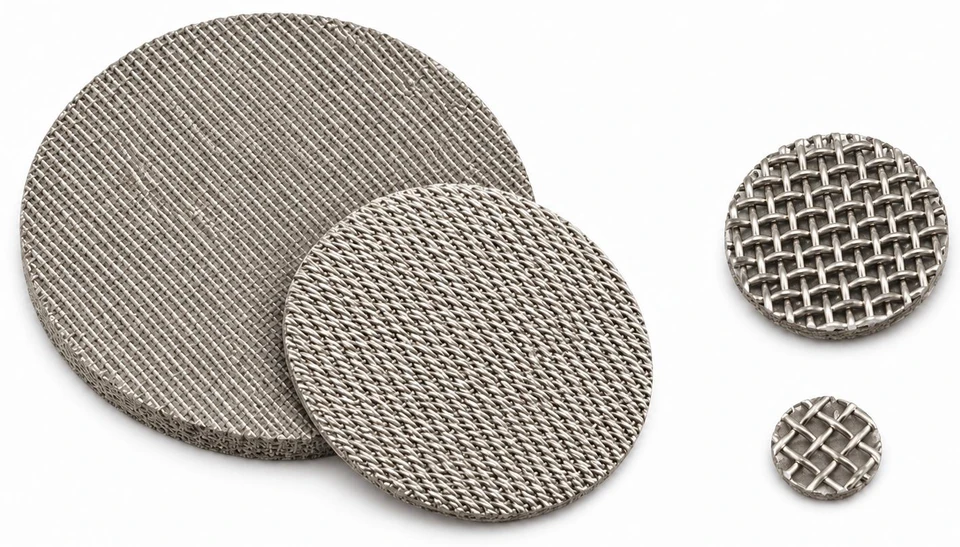
Sintering bonds wire contact points through a controlled thermal process. Combining a filtration layer with coarser supporting layers can produce a rigid porous laminate.
Five Layer Laminate
Five stainless steel mesh layers, consolidated together.
Square Aperture Laminate
Multiple layers of plain square aperture mesh.
Perforated Plate Laminate
Perforated backing plate bonded with mesh layers.
Dutch Weave Laminate
Two or three crossed dense weave layers.
Bonding and Structural Support
The filtration layer and the supporting layers perform different functions. Specify the entire laminate, its orientation and the unsupported span. Sintering improves cohesion, while the final strength also depends on the support and component geometry.
Qualify the Finished Component
Request the retention test basis, clean flow resistance and allowable differential pressure for the supplied laminate and assembly. No universal micron, pressure or temperature rating is stated on the product page.
Cylinders and Compressed Mesh Parts
Different Constructions for Different Duties
Mesh cylinders may be single or multilayer, with smooth or pleated surfaces. Media include woven mesh, Dutch weave and sintered fibre.
Smooth and Pleated Filter Cylinders | Two Ways to Form a Cylindrical Surface
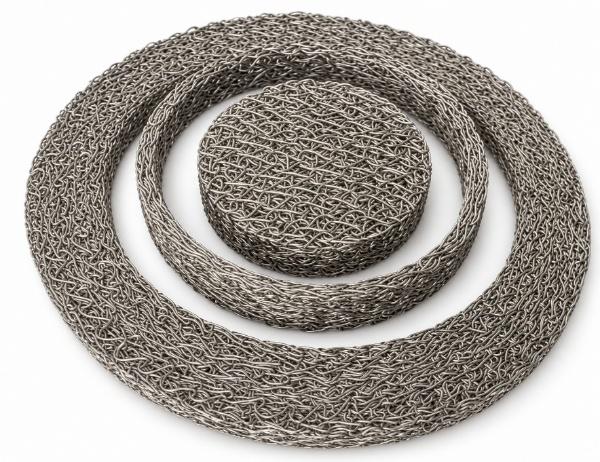
For cylindrical parts, define diameter, length, seam, end connections, support core and flow direction. Calculate the effective media area from the finished construction; pleat count alone does not define usable flow area.
Mesh Count, Aperture and Open Area
Specify More Than a Mesh Number
d = wire diameter; w = clear opening; p = centre to centre pitch. p = w + d. Projected geometry; wire crimp is omitted.
For regular square aperture cloth, wire diameter and pitch determine the clear opening. Measure aperture over multiple pitches where appropriate and record the weave with the dimensions.
M = mesh count per inch; p, w and d in mm. Relationships for square aperture mesh.
Calculated geometric examples, not catalogue grades. They exclude rims, joints, supporting layers and layer overlap. Confirm available mesh combinations and tolerances.
Same mesh count, different opening. The two 100 mesh examples show why wire diameter must accompany mesh count: the clear openings are 154 µm and 174 µm respectively.
Dutch Weave, Fibre and Multilayer Media
The square opening formula does not determine the retention rating of Dutch weave, fibre felt or a completed multilayer pack. Obtain the specified retention efficiency and test method for the actual medium.
Application and Technical Review
Match the Screen to the Operating Process
Process Requirements
Polymer filtration needs vary with contamination load, gel behaviour and melt properties. Screen packs and filter discs should be selected as complete media arrangements for the process.
Fluid and Contamination
State polymer or liquid grade, viscosity basis, temperature and flow range. Describe solids, gels or other contamination, the current filter and the required improvement.
Retention and Resistance
Define particle size, removal efficiency and the accepted test basis. Evaluate clean pressure loss and pressure rise as the screen loads; include support plate and layer stack resistance.
Mechanical Construction
Supply the drawing, material grade, thickness, media sequence, joining details and support arrangement. Confirm working pressure, allowable differential pressure, transients and change out limit.
Manufacturing Acceptance
Agree profile tolerances, weave or media identification, edge condition, joining inspection, cleanliness, packaging and traceability. Link any supplied sample to a drawing revision.
Trial and Maintenance
Compare candidate screens at matched operating conditions. Record initial pressure drop, pressure rise per hour or tonne, run duration and downstream quality.
For spinning, track spinneret blockage and filament breaks; for film, use the agreed defect measure.
Where reuse is intended, validate the cleaning method against the medium, deposits and finished construction.
Post cleaning flow and integrity checks should use an approved baseline and acceptance criteria for that filter design.
Complete the Enquiry
Include quantity, annual consumption, delivery requirement and documentation. Obtain confirmation of the finished screen’s material, retention and operating limits before approving the supply specification.
Polymer Filtration
Filter media selected for melt conditions and the required particle retention.
Material Selection
Match media construction to temperature, pressure and polymer compatibility.
Technical Support
Discuss filtration area, throughput and pressure drop for the application.