



Circular, annular, rectangular and application specific capillary plates are specified from verified machine interfaces, polymer data and filament requirements. Typical materials processed include PET, PA6, PA66, PP, acrylic, rayon and speciality fibres. Final plate form, capillary profile, material, finish, tolerance and inspection records are confirmed against the approved drawing and application duty.
Spinnerets — Applications and Selection
For Synthetic Fibre Spinning
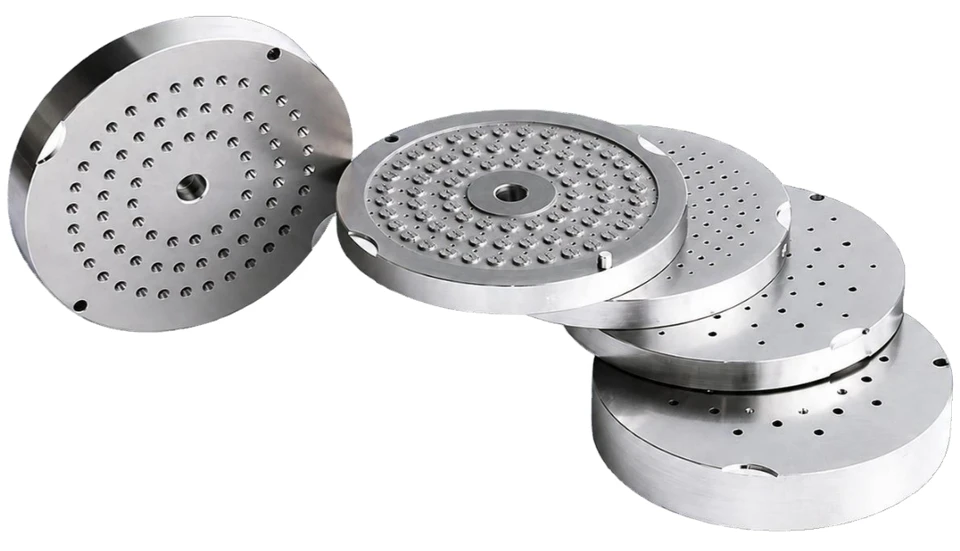
Precision Capillary Plates for Controlled Filament Formation
The spinneret forms the final flow passages before polymer melt or solution becomes individual filaments. Geometry must match the material, spinning route, throughput per hole, quench field and required product. Each spinneret is released against a verified drawing or qualified sample and an agreed process and inspection basis.
POY & FDY Filament
Hole to hole flow consistency, plate pattern, quench exposure and target Linear Density.
BCF & Industrial Yarn
Throughput, filament profile, pressure stability and robust cleaning practice.
Staple Fibre
High hole count, distribution across the active area and repeatable capillary condition.
Monofilament & Specialty
Application specific diameter or profile, material compatibility and surface finish.
From Metered Polymer to Filament Streams
Each capillary defines the final controlled passage through which polymer flows. Hole count, pitch and layout establish the number and spatial distribution of emerging filaments. Consistent dimensions, clean transitions and an undamaged exit face help filaments emerge under comparable conditions.
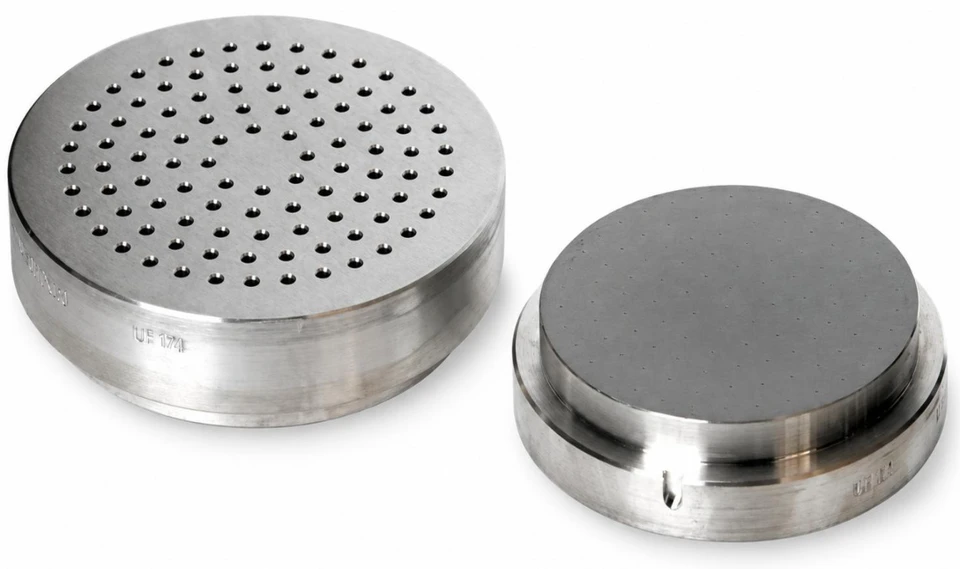
Final filament properties must be qualified on the complete spinning line. Polymer preparation, filtration, metering, temperature, quench and downstream drawing all contribute to the result.
Design Variables
Capillary Profile
Round, trilobal, multilobal, hollow, slot or another defined cross section.
Diameter / Slit Width
Selected with polymer rheology, throughput per hole, drawdown and target filament size.
Capillary Length / L/D
Affects pressure loss, flow development, elastic recovery and cleaning access.
Entry and Transition
Counterbore, countersink and land transition guide polymer into the final passage.
Hole Count and Arrangement
Concentric, square, diamond, linear or partitioned layouts coordinate filament count and the quench field.
Plate and Sealing Interface
Outside form, thickness, locating features, seating face and orientation must match the pack and beam.
Small changes can affect pressure, shear history, residence behaviour, extrudate swell, cleanability and quench interaction. Dimensions, datums, inspection methods and acceptance criteria must be agreed together; a nominal hole size alone is not a complete specification.
Spinning Routes
Melt Spinning
- Feed and Solidification
- Molten polymer is extruded and solidified by cooling in air, water or another medium.
- Design Emphasis
- Rheology, temperature, capillary flow, die swell, quench pattern and throughput per hole.
Dry Spinning
- Feed and Solidification
- Polymer solution is extruded into heated gas while solvent is removed.
- Design Emphasis
- Solution compatibility, transition quality, hole profile, residence behaviour and solvent compatible materials.
Wet Spinning
- Feed and Solidification
- Polymer solution is extruded directly into a coagulation bath.
- Design Emphasis
- Hole count, bath compatibility, jet stability, plate layout and corrosion resistant metallurgy where required.
Dry Jet Wet / Air Gap
- Feed and Solidification
- Solution passes through an air gap before entering the coagulation bath.
- Design Emphasis
- Uniform capillaries, jet path, air gap stability, plate alignment and controlled solution delivery.
Melt
Polyester, polyamide, polypropylene, polyurethane and other melt spinnable polymers.
Dry
Acetate, acrylic, elastomeric and other compatible solution spun systems.
Wet / Air Gap
Rayon, acrylic, PAN precursor, aramid and other coagulation spun systems.
Polymer or solution composition, additives, temperature, pressure, solvent and coagulant exposure, and cleaning chemistry govern the final material and finish.
Filament Geometry
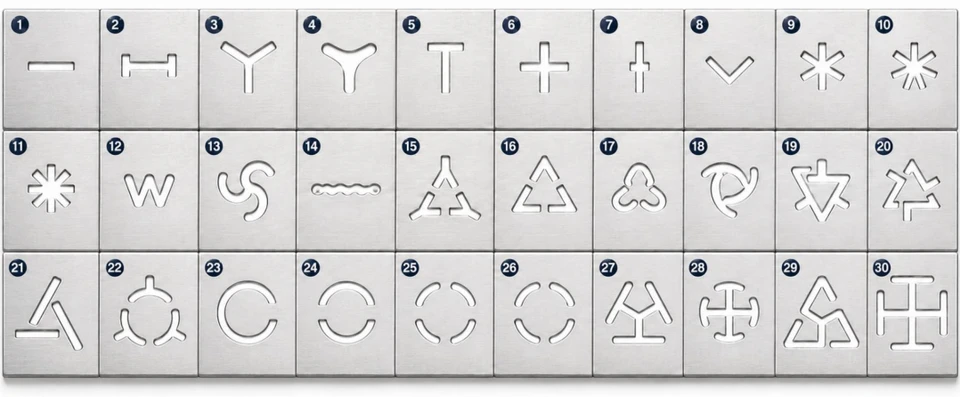
Profiled holes can create optical, tactile, transport, bulk or functional effects. The final fibre profile is not a direct copy of the hole: rheology, swell, drawdown, quench and solidification modify the emerging stream.
Round
General Textile, Industrial, Staple and Monofilament duties.
Tri Lobal / Multi Lobal
Modified lustre, cover, bulk, capillary channels or optical effects.
Hollow / Segmented
Lower apparent density, insulation, bulk or fluid transport functionality.
Flat / Ribbon / Slot
Surface area, flexural response, reflectance or application specific geometry.
Complex / Multicomponent
Sheath core, side by side, islands in sea or other engineered structures requiring matched polymer paths.
Approve both the spinneret dimensions and the achieved filament cross section under the intended throughput, temperature, quench and draw conditions.
Capillary Flow
Geometry, polymer rheology and throughput must be evaluated together. The same capillary can behave differently when viscosity, temperature, degradation state or throughput changes.
Diameter / Flow Area
- Primary Process Effect
- Changes average velocity, shear and pressure requirement at a given throughput.
- Qualification Question
- Can the target mass flow per hole be achieved within the approved pressure window?
Capillary Length / L/D
- Primary Process Effect
- Changes pressure loss and the degree of flow development before the exit.
- Qualification Question
- Does the profile remain stable and cleanable for the selected polymer?
Entry Transition
- Primary Process Effect
- Influences acceleration, local shear and potential stagnation at the passage entrance.
- Qualification Question
- Is the transition smooth, concentric and reproducible across the plate?
Polymer Viscosity
- Primary Process Effect
- Changes pressure, shear stress, swell and sensitivity to temperature or residence time.
- Qualification Question
- Which viscosity, IV/MFI or solution concentration basis governs the design?
Throughput per Hole
- Primary Process Effect
- Directly changes mass flow, jet velocity and downstream attenuation demand.
- Qualification Question
- Is throughput defined per pack and per active capillary?
Temperature
- Primary Process Effect
- Changes viscosity, relaxation and degradation risk.
- Qualification Question
- Are normal, start up and maximum temperatures documented?
Final linear density is primarily a mass throughput and take up relationship. Capillary diameter influences flow and spinnability but is not a standalone predictor of final linear density. For hollow or complex sections, qualify the actual filament profile rather than relying only on the machined outline.
Precision and Inspection
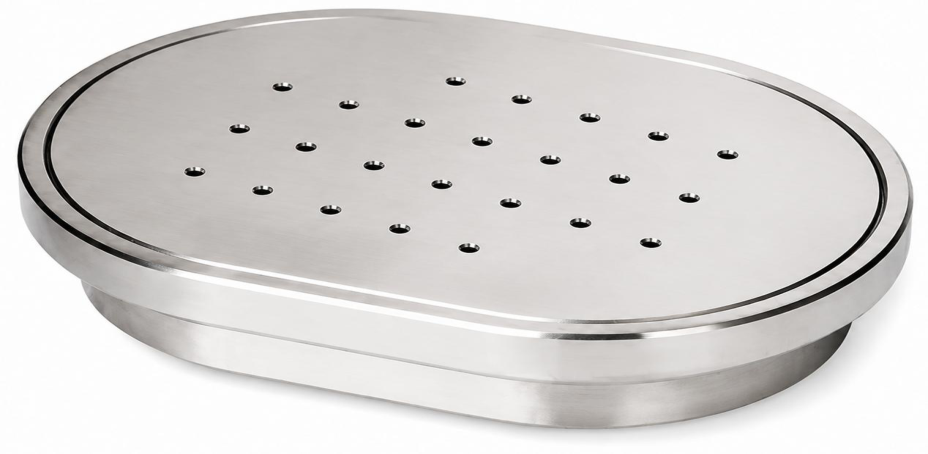
Inspection must cover the complete capillary, including entry, transition and exit. Burrs, deposits, wear, distortion and partial blockage can alter an individual stream even when the plate still fits the machine.
Capillary Size and Length
Verify tolerance, measurement method, sampling or 100% inspection and acceptance level.
Profile Symmetry and Orientation
Control widths, radii, angles, segment spacing and rotational position for irregular holes.
Entry and Transition
Check concentricity, surface condition and absence of machining damage or contamination.
Exit Face Condition
Confirm clean edges without burrs, dents, scratches, deposits or polishing damage.
Hole to Hole Consistency
Assess reproducibility across the active spinning area and identify plugged, worn or deformed capillaries.
Achievable tolerance depends on hole size, profile, length, material and inspection method. The applicable tolerance grade must be stated on the approved drawing and quotation.
Materials and Construction
Spinnerets may be produced in stainless steels or other alloys resistant to corrosion and temperature. Selection considers the spinning medium, thermal cycle, cleaning method, mechanical loading and required service life.
Base Material
Strength at operating temperature, corrosion compatibility, machinability and dimensional stability.
Surface Condition
Specified working face, entry, transition and capillary finish; mirror, honed or other finish only where technically justified.
Plate Form
Circular, annular, rectangular, segmental or custom geometry to the verified pack interface.
Thickness and Support
Pressure loading, stiffness, seating and deflection risk across the active area.
Sealing and Location
Outside diameter/profile, lands, shoulders, bolt pattern, keys, orientation and gasket interface.
Cleaning Compatibility
Thermal, chemical, ultrasonic, hydrolytic or mechanical methods must not attack the alloy or precision surfaces.
Traceability
Material identification, drawing revision, serial or batch marking and agreed inspection documentation.
A visually similar plate is not automatically interchangeable. Verify the complete machine interface, active area, capillary geometry and pressure and temperature duty. Specific alloys, hardness, finish, treatments and certificates are confirmed in the technical commercial offer.
Filament and Yarn Quality
Spinneret geometry and cleanliness influence individual flow passages. Final yarn properties also depend on polymer quality, filtration, metering, temperature, quench, spin finish, drawing and heat treatment.
Linear Density / Decitex / Denier
- Spinneret Related Mechanism
- Differences in flow area and condition can change relative mass flow between holes.
- Interpretation
- Total linear density is governed mainly by mass throughput and take up; compare both average and variation.
Filament Evenness
- Spinneret Related Mechanism
- Dimensional variation, deposits and partial blockage can disturb filament consistency.
- Interpretation
- Monitor variation between and within packages under stable process conditions.
Cross Section / Profile Degree
- Spinneret Related Mechanism
- Capillary outline and transition establish the nominal shape.
- Interpretation
- The final profile also depends on swell, drawdown, quench and solidification.
Tenacity
- Spinneret Related Mechanism
- Uneven filaments or defects may contribute to weak filaments and breaks.
- Interpretation
- The effect is indirect; polymer molecular condition, orientation, crystallinity and draw history are decisive.
Elongation
- Spinneret Related Mechanism
- Flow or quench variation can produce inconsistent draw response.
- Interpretation
- The effect is indirect and must be assessed under the same draw and heat setting conditions.
Breaks / Operability
- Spinneret Related Mechanism
- Burrs, contamination, plugged holes or unstable profiles can disrupt jet formation.
- Interpretation
- Record break rate, drip, smoke, pressure trend and affected hole positions.
Appearance / Dye Uniformity
- Spinneret Related Mechanism
- Cross section or mass flow variation can change optical response and downstream behaviour.
- Interpretation
- Correlate findings with dyeing, lustre, streaks and fabric inspection; exclude other causes.
A precision spinneret supports uniformity and stable operation. It cannot compensate for degraded polymer, poor filtration, unstable metering, uneven quench or incorrect drawing conditions.
Cleaning and Lifecycle
A validated cleaning method must remove deposits and restore flow without altering the capillary. Aggressive cleaning can round edges, enlarge holes, scratch faces or leave residues. Identify and log the plate, inspect damage and blockage, clean by the approved method, inspect capillaries and faces, then release with traceable status.
Incoming Condition
Record plate identity, drawing revision, service history, contamination and visible damage.
Cleaning Route
Define thermal / chemical / ultrasonic / mechanical stages, limits, rinsing and drying for the actual polymer.
Post Clean Inspection
Check every critical hole where required; verify face, transition, size / profile and residue status.
Repair Decision
Approve re polishing, deblocking or capillary repair only against documented dimensional limits.
Retirement Criteria
Remove plates with out of tolerance holes, cracks, excessive wear, distorted seating or unrecoverable damage.
Storage and Handling
Protect precision faces and capillaries from impact, corrosion, dust and mixed identity.
Link each spinneret identity to cleaning count, inspection findings, pressure behaviour, breaks and product results to establish evidence based reuse limits.
Manufacturing and Quality Control
The manufacturing route depends on plate material, hole size, profile and quantity. Review the duty and drawing, confirm material grade and traceability, machine the plate and passages, finish faces and capillaries, inspect dimensions and condition, then release with records and protective packing.
Approved Drawing
Revision, material, dimensions, datum system, hole profile, layout, tolerances and finish.
Material Record
Grade and certificate level where specified in the order.
Dimensional Report
Critical external dimensions, thickness, locating and sealing features.
Capillary Inspection
Method, acceptance basis and results for size/profile, length, symmetry, orientation and condition.
Visual / Face Inspection
Entry, exit, working faces, markings and absence of damage or contamination.
Identification and Packing
Part number, drawing revision, lot/serial identity and protection of precision surfaces.
Agree sampling or 100% inspection, calibrated equipment, measurement uncertainty and supplied reports before manufacture. Manufacturing origin, certifications, tolerance capability and documentation scope are confirmed in each quotation.
Selection Data
Provide the approved drawing, clear face and side photographs, polymer and process data, existing spinneret history, quality issue, cleaning method and expected annual quantity. Missing process data should be resolved before finalising capillary geometry or material.
Plant Qualification
Compare the proposed spinneret with the current approved component under representative conditions. Keep polymer, filtration, metering, temperature, quench and downstream settings comparable wherever practical.
Fit and Sealing
- Record
- Assembly, orientation, seating, leakage and removal condition.
- Decision Value
- Confirms machine interface and handling.
Pressure and Throughput
- Record
- Startup, steady state and trends at controlled temperature and polymer condition.
- Decision Value
- Checks flow resistance and operational stability.
Filament Formation
- Record
- Active holes, drip, smoke, profile stability, breaks and affected positions.
- Decision Value
- Identifies local capillary or process interaction.
Linear Density / Evenness
- Record
- Average dtex or denier, variation and consistency between packages.
- Decision Value
- Confirms mass flow and process repeatability.
Tensile Properties
- Record
- Breaking force or tenacity and elongation using the agreed method.
- Decision Value
- Confirms final product under the same downstream conditions.
Cross Section / Appearance
- Record
- Microscopy, profile degree, lustre, dyeing or fabric results where relevant.
- Decision Value
- Links geometry to the commercial product objective.
Establish the approved baseline, run the trial under matched conditions, inspect both the product and plate, and decide against agreed evidence and limits. Agree conditioning, instruments, sample size and applicable test methods before the trial. For yarn from packages, applicable test methods include ISO 2060 for linear density and ISO 2062 for breaking force and elongation; confirm their applicability to the product and agreed testing basis.
Application Review and Controlled Supply
Application review progresses from polymer and product duty through drawing and capillary review, sample approval and controlled trials to routine supply against agreed controls.
Geometry and Fit
Approved drawing or verified sample, machine interface, sealing, orientation and active area.
Capillary Design
Profile, diameter / slit width, length / L/D, entry transition, count, pitch and layout.
Material and Finish
Selection against polymer / solution chemistry, temperature, pressure, cleaning and service life target.
Verification
Agreed dimensional, visual and capillary inspection with defined acceptance criteria.
Qualification
Plant trial plan covering fit, pressure, throughput, operability, filament geometry and product quality.
Supply Documentation
Quotation, approved specification, inspection records, identification, packing and delivery schedule.
The supply basis combines correct machine fit, defined capillary geometry, traceable inspection criteria and controlled plant qualification for textile and industrial filament, staple fibre, monofilament, profiled and selected speciality fibre spinnerets.
Precision Capillaries
Hole geometry and dimensions selected for the required filament formation.
Material Selection
Construction matched to the polymer and spinning conditions.
Technical Support
Discuss capillary design, filament count and the intended yarn specification.