



How Friction Discs Generate Twist
In false twist texturing, rotating friction discs insert twist into the yarn upstream of the unit, through the heating and cooling zones. The filaments are heated and cooled in this twisted state. The yarn untwists as it leaves the unit, while the deformation set into the filaments produces crimp when the yarn relaxes.
Yarn Path Through the Discs
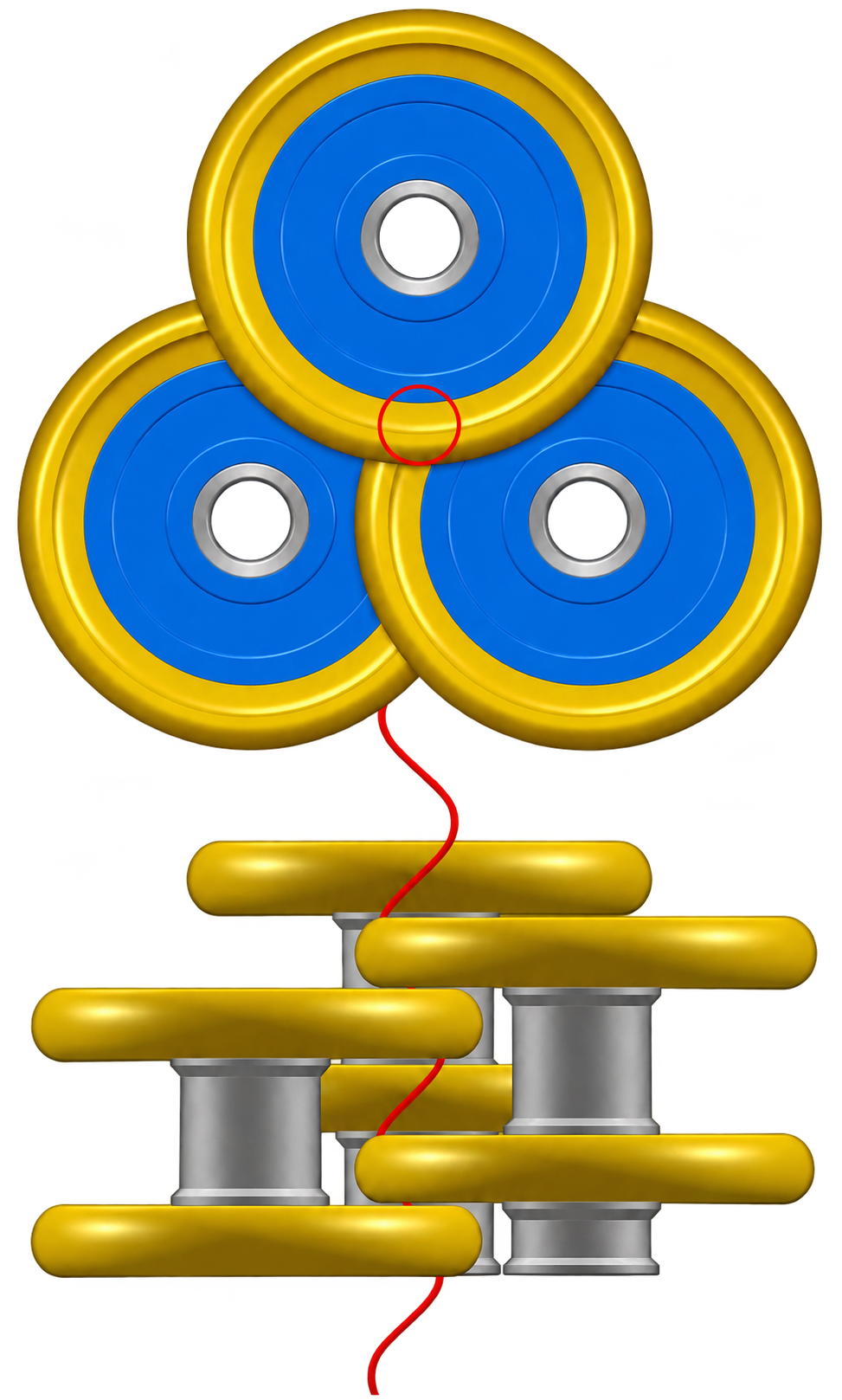
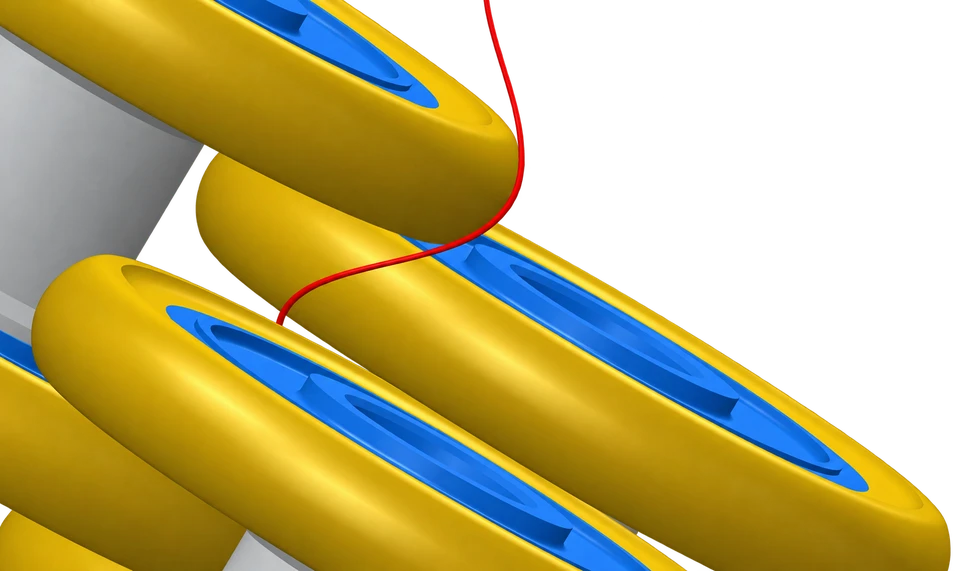
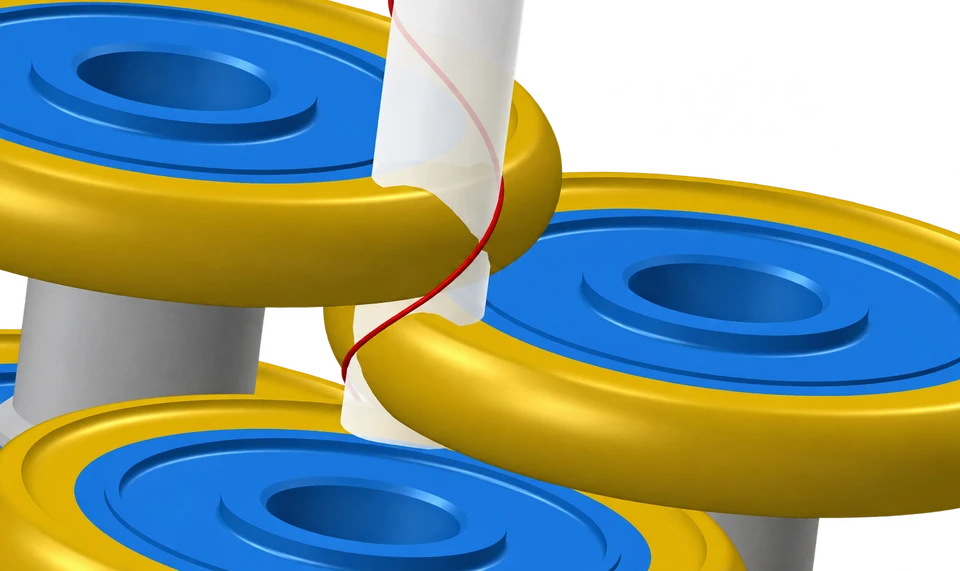
In a three spindle friction unit, staggered discs guide the yarn through the central overlap region along an approximately spiral path. The imaginary cylinder in the illustration shows how this path relates to the disc configuration.
Disc Geometry and Yarn Contact
The disc configuration sets the yarn angle and contact with the working surfaces. This geometry provides a basis for calculating theoretical twist.
Twist Generation
Contact with the rotating discs turns the yarn about its own axis and helps transport it through the unit. Actual twist depends on the geometry, yarn properties, frictional contact and operating conditions.
Why Twist Level Matters
Production Speed and Twist Level
For 150 denier polyester yarn, measurements on machines from leading manufacturers indicate twist levels of approximately 57 to 58 turns per inch (TPI). This provides a reference when evaluating twist level alongside production speed and yarn quality.
As an operating guideline, production speed is typically set 20% below the onset of surging for the selected yarn and process settings. Surging involves unstable yarn motion and tension fluctuations.
This operating margin accounts for differences between texturing machine positions and variations in POY draw force.
Yarn Structure and Bulk
Twist shapes the filaments during heat setting, creating the deformation that develops into crimp after untwisting and relaxation. This crimp gives the yarn bulk, stretch and resilience.
The required structure depends on a balance of twist, yarn temperature, heating time, cooling, draw ratio and tension ratio.
Excessive tension can restrict crimp development, while inadequate heat setting can reduce its permanence. Settings should achieve the required bulk and recovery while preserving yarn strength and filament integrity.
Fabric Appearance
Consistent twist supports uniform crimp and bulk, influencing fabric cover, surface texture, light reflection and handle. Variations between yarn packages or texturing positions can contribute to uneven texture and apparent shade differences.
Twist must be controlled alongside draw ratio, temperature and tension because these conditions also influence filament structure and dye uptake.
Maintaining consistent processing conditions helps reduce the risk of streaks and barré. Fabric trials provide a practical check on appearance, handle and dyeing uniformity.
Disc Geometry and Configuration
Assess these dimensions and settings together when selecting the disc configuration.
- Spindle Centre Distance
-
Spindle centre distance determines the overlap between discs of a given diameter. It shapes the central yarn path and the contact angle on each working disc, influencing the balance between twisting and forwarding forces.
Spindle spacing and disc diameter must therefore be assessed together.
- Disc Diameter and Thickness
-
Disc diameter determines overlap, while disc thickness influences the yarn path through the configuration. Together, they affect yarn angle and contact geometry.
With spindle centre distance, disc thickness and spacing unchanged, increasing disc diameter reduces twist levels by changing the yarn contact angle.
- Disc Edge Profile
-
The working edge radius and shape influence yarn contact, wrap and the direction of frictional forces. Together with disc material and surface finish, the profile affects torque transmission and yarn forwarding.
Consistent profiles and good surface condition help maintain repeatable performance.
- Number of Working Discs
-
Working discs provide successive contacts that twist and forward the yarn. Select their number to suit yarn count, filament characteristics, disc material and the required performance.
A 1/4/1 disc configuration comprises one entry guide disc, four working discs and one exit disc.
- Spacing Between Discs
-
Spacers position the discs along the spindles and establish their clearances. These dimensions influence the yarn path, contact angle and wrap between successive discs.
Disc thickness and spacer dimensions must be matched to maintain the intended geometry throughout the unit.
- Entry Guide Disc
-
The entry guide directs the yarn onto the first working disc. An asymmetric profile or suitably smaller outside diameter helps establish the required yarn angle.
Its polished surface provides smooth guidance. On units with fixed spindle centres, smaller entry and exit discs can also improve threading access.
- Exit Knife Disc
-
A suitably smaller exit disc maintains the required yarn angle on the last working disc.
Its narrow, polished knife edge profile promotes efficient detwisting, allowing the heat set crimp to develop as the yarn relaxes and helping reduce tight spots.
- D/Y Parameter
-
D/Y is the ratio of disc surface speed to yarn speed.
It influences how the discs transfer torque to the yarn, generating and maintaining twist upstream through the cooling zone and heater.
It also affects yarn transport through the disc configuration and influences the balance between T1 (yarn tension before the friction unit) and T2 (yarn tension after the unit).
Increasing D/Y does not increase twist levels, as twist also depends on disc and tri spindle geometry, friction and yarn tension.
Very high D/Y may have a small effect on twist, as the high disc surface speed can distort the yarn angle on the discs.
- Yarn Angle
-
Twist Measurement
Check calculated twist against measured values and assess yarn tension for the selected disc configuration.
A snatch test captures the temporarily twisted yarn in the cooling zone so that its twist can be measured. Trained personnel should use suitable equipment and follow the machine’s approved sampling procedure to preserve the twist in the captured sample.
Secure the sample at a known test length and untwist it until the filaments are parallel. Calculate turns per inch (TPI) or turns per metre (TPM) as follows:
TPI = Turns removed ÷ sample length in inches
TPM = Turns removed ÷ sample length in metres
Repeat the measurement and record the sampling method, yarn specification and machine settings for meaningful comparisons.
Confirming Yarn Quality
Assess measured twist alongside crimp contraction, crimp stability, strength, elongation and fabric performance.
Crimp contraction indicates the shortening associated with crimp development; crimp stability indicates how well that crimp is retained after a defined loading cycle.
TSP Process Expertise
TSP provides disc configuration assessments, twist and tension evaluations, and recommended process settings for your yarn and machinery. Our empirical calculation models help estimate twist levels and compare disc combinations.
We support production trials to refine these recommendations against yarn and fabric performance. The aim is to meet quality requirements at a stable, commercially effective production speed.